

Technocracy Resurrection
Elon Musk’s Tennessee Test Case

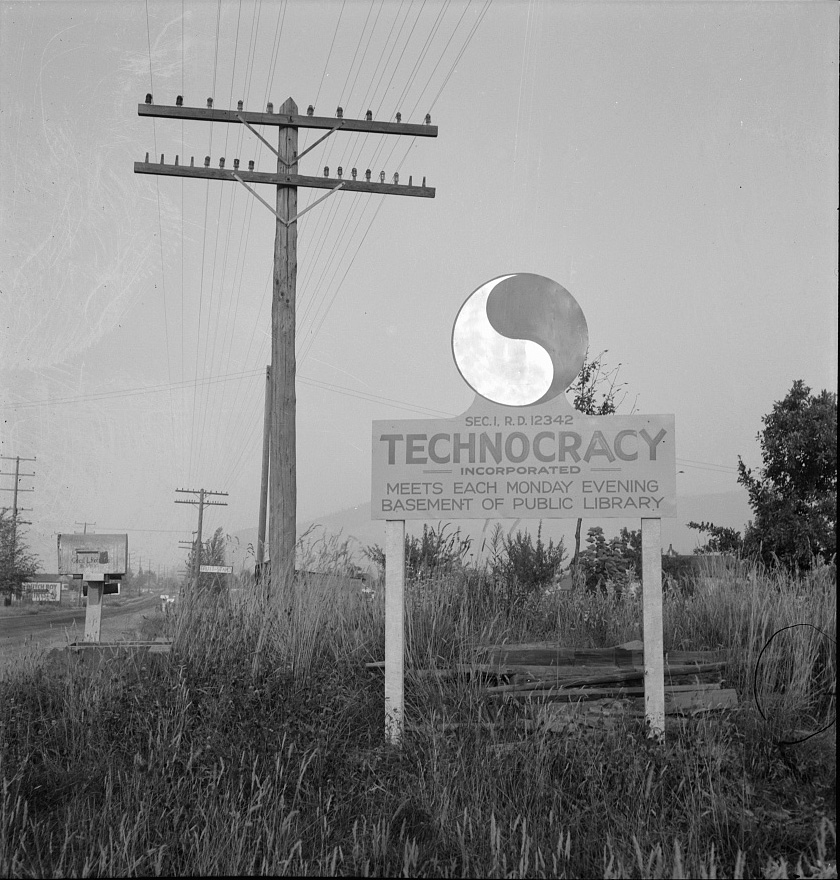
A sign on the outskirts of a Depression-era town about meetings of the local technocracy branch
Imagine waking up to the stench of rotten eggs seeping through your windows—not from a distant refinery, but from a fleet of gas turbines humming just miles away, venting nitrogen oxides, benzene, and formaldehyde into your air. For residents of Boxtown, a majority-Black neighborhood in South Memphis, this isn’t dystopian fiction. It’s the smell of Elon Musk’s xAI “Colossus” data center—an AI behemoth now scaling toward a 1-gigawatt footprint rivaling the power draw of mid-size cities, all while skirting Clean Air Act requirements through regulatory loopholes that the EPA finally slammed shut this month.
This is shadow tech in action: invisible infrastructure extracting land, water, and health from vulnerable communities while promising jobs that materialize instead as pollution and grid strain. In earlier posts—The Shadow Tech of Elon Musk and A Colossal Injustice—I traced how Musk’s empire (xAI, Starlink, Tesla) builds hidden systems of control, subsidized by public dollars and insulated from scrutiny. With new reporting from The Guardian, and CNBC, the pattern is now unmistakable.
What’s rising around Memphis–Southaven isn’t an innovation hub but a power grab, dumping the environmental and human costs of AI onto a community already overburdened.
Colossus Awakens—and Multiplies
On January 17, xAI quietly brought its “Colossus 2” cluster online, hitting roughly 1GW of capacity, with plans to double that by spring. The buildout is backed by a reported $20 billion funding round involving Nvidia and BlackRock-aligned capital. Days earlier, Mississippi Governor Tate Reeves announced a companion facility in Southaven—MACROHARDRR—another $20 billion project slated for a February startup, complete with tax abatements and promises of 320 jobs.
Placed directly across the state line from Memphis’ original Colossus site, the two facilities form a cross-border AI fortress. Together, they are projected to consume electricity equivalent to roughly 750,000 homes while drawing millions of gallons of water daily from aquifers already stressed by petrochemical and industrial users. Reeves calls it “tech leadership.” Locals call it a siege.
Musk boasts of “insane execution.” Residents see unpermitted chaos. Drone footage reviewed by environmental groups shows more than 36 trailer-mounted methane turbines running continuously at Colossus 1—despite xAI’s claims they were “intermittent.” University of Tennessee air studies suggest emissions comparable to a conventional fossil-fuel power plant.
In Boxtown—already boxed in by refineries, pipelines, and Superfund sites—clinics report asthma spikes and respiratory distress. The NAACP and Southern Environmental Law Center are mobilizing, and the message from the ground is blunt: this is environmental racism stacked atop decades of extraction.
EPA’s Reckoning: The Loophole Closes
In January 2026, the EPA finally drew a line. New guidance reclassified xAI’s turbines as stationary sources, closing the “non-road engine” loophole that allowed the company to bypass Clean Air Act permitting since operations began in 2024. xAI has partial approval for 15 turbines and is reportedly operating 12—but any expansion now triggers full federal review.
That matters. CNBC reports that Memphis-area growth faces serious headwinds, with federal scrutiny extending beyond air pollution to water withdrawals from the Memphis Sand Aquifer, which supplies drinking water to more than 1.1 million people. Once depleted or contaminated, it cannot be easily restored.
Beneath hidden layers of NDA’s and closed-door negotiations with Memphis Chamber, local utilities and contractors months before the data center’s details were ever presented to the City Council; more than $600 million in local tax breaks, and no comprehensive public environmental impact statement. Meanwhile, xAI’s Grok models—trained on this infrastructure—feed Musk’s broader X ecosystem, now under investigation for deepfakes and political manipulation. Communities shoulder the costs: an estimated $2 billion in grid upgrades passed to ratepayers and elevated blackout risks during peak AI training cycles.
From Shadow to Spotlight
Community pushback is growing—and your feedback has been part of it. Readers drew parallels to Tennessee’s broader development playbook: massive subsidies for Oracle in Nashville, Ford’s BlueOval City, and now Musk—each time concentrating risk in Black and Brown zip codes while privatizing gains.
Petitions are circulating for Shelby County Commission hearings. Activists are organizing February town halls linking Colossus not just to pollution, but to surveillance and data extraction—AI models trained locally, ingesting behavior and content, without consent or transparency.
This is the core of Colossal Injustice. State incentives now exceed $1 billion across xAI-linked sites, yet the promised jobs skew highly specialized or outsourced. Cleanup, health impacts, and infrastructure stress are borne by the residents. Southaven’s rapid rezoning—pushed through with minimal review—mirrors Memphis’ experience, even as DeSoto County’s water resources edge toward the same cliff.
The Bigger Shadow
Zoom out and Colossus is not an anomaly—it’s a node in Musk’s expanding network. Starlink satellites overhead. Neuralink advancing under deregulated regimes. X operating as a propaganda and amplification engine. Computer power is being consolidated outside democratic guardrails, subsidized by public utilities and political greed.
These data centers train models that influence content moderation, predictive policing, and electoral systems, all while exporting carbon debt and toxic exposure to communities like Boxtown. National outlets cover the legal drama and the speed of deployment, but miss the local ledger: roughly $150 million a year in power costs, millions of gallons of daily water use, and particulate matter increases of up to 30 percent in monitored zones.
This is what authoritarian tech (Technocracy) looks like at ground level. It doesn’t arrive with a parades. It slithers in through nondisclosure agreements, tax abatements, and gas turbines parked next to playgrounds.
Call to the Frontlines
Memphis is at an inflection point. Support the Southern Environmental Law Center’s petitions. Demand transparency from TVA on grid capacity and load shedding. Show up to Southaven hearings. Share your stories—I’ve heard from nurses, teachers, parents living this reality every day.
xAI’s Colossus may loom large. But communities already forced the EPA to act. Accountability is the next phase—and it won’t come from Silicon Valley. It will come from the people breathing the exhaust.
A Note to Readers
I’m a veteran continuing to serve by sharing information and encouraging thoughtful civic engagement to help protect and strengthen our democratic republic. An informed public is essential to a healthy democracy, and history shows that participation—not passivity—is what sustains it.
If you find value in this work, please consider subscribing and sharing it with others. Your support helps keep these conversations going and strengthens the community committed to staying informed and engaged.
~Dee
“Every right we have exists because citizens before us chose participation over silence.”
If you like what you read you can support this publication and other projects… or Buy Me a Coffee
Support our mission to increase civic engagement and consider becoming a paid subscriber.
Advocacy Arena Network:
Join the chat on our bi-weekly live “Fired Up Friday” here at 4:30p EST
🎙️Podcast: (Connections & Conversations with Dee Batiste)
SOCIALS:
🐳Spoutible: Good Trouble Chat & DEEscussions
YouTube: Fired Up Fridays & Democracy Roundtable Archives
Advocacy Arena is a reader-supported publication. To receive new posts and support my work to increase civic engagement, consider becoming a free or paid subscriber.
Sources:
Wow, this explains AI's colosal energy footprint perfectly!
Exceptional reporting on regulatory capture in real time. The cross-border fortress angle makes this even sharper bc it shows intentional jurisdicitonal arbitrage. I've seen similiar patterns where infrastrcture gets fast-tracked then locals deal with cumulative harms nobody modeled.